
As of March 2025, the Grande Foundation has rebranded as the Advanced Manufacturing Institute San Diego (AMI-SD) with a new website https://advancedmfginstitutesd.com/
Upon acceptance to the Grande Manufacturing Training Academy, trainees will partake in training at the QCMI facility. Typically, the trainer-to-trainee ratio is 1:10 with the goal of fostering a more personal learning experience for the students. For this reason, this number will not exceed 1:20 throughout the entirety of the course. All trainers are currently employed at QCMI and have had over 30 years of experience in the manufacturing industry. Students will become proficient in a variety of areas in the manufacturing and machining industry while they undergo the Manufacturing Academy.
Areas that are focused on during training include:
- Becoming familiar with inspection equipment (Coordinate Measuring Machines, Gauge Production including measuring up to .00005″ accuracy, and Surface Table Equipment)
- Spending time on the shop floor and the machines working on jobs in production
- Manual and CNC Machining (HAAS and other leading CNC machines)
- Non-Destructive Testing (Fluorescent Penetrant Inspection, Magnetic Particle Inspection)
- Aerospace Quality Requirements (Quality Clinic is used by United Technologies and other leading aerospace companies)
- Understanding the evolving changes of the manufacturing industry and learning how to adjust to the needs of a specific region

Upon completion of the Academy Program, individuals will become machinist interns and will contribute to projects that are currently in progress in various departments within the shop. Manufacturing positions that graduates may receive once the entire program is complete include Inspectors, Machinists (Manual/CNC), Non-Destructive Testing Inspectors, Quality Technicians, and other roles in the manufacturing industry that may arise based on the needs of the particular region or the industry as a whole.
Six Sigma Methodology
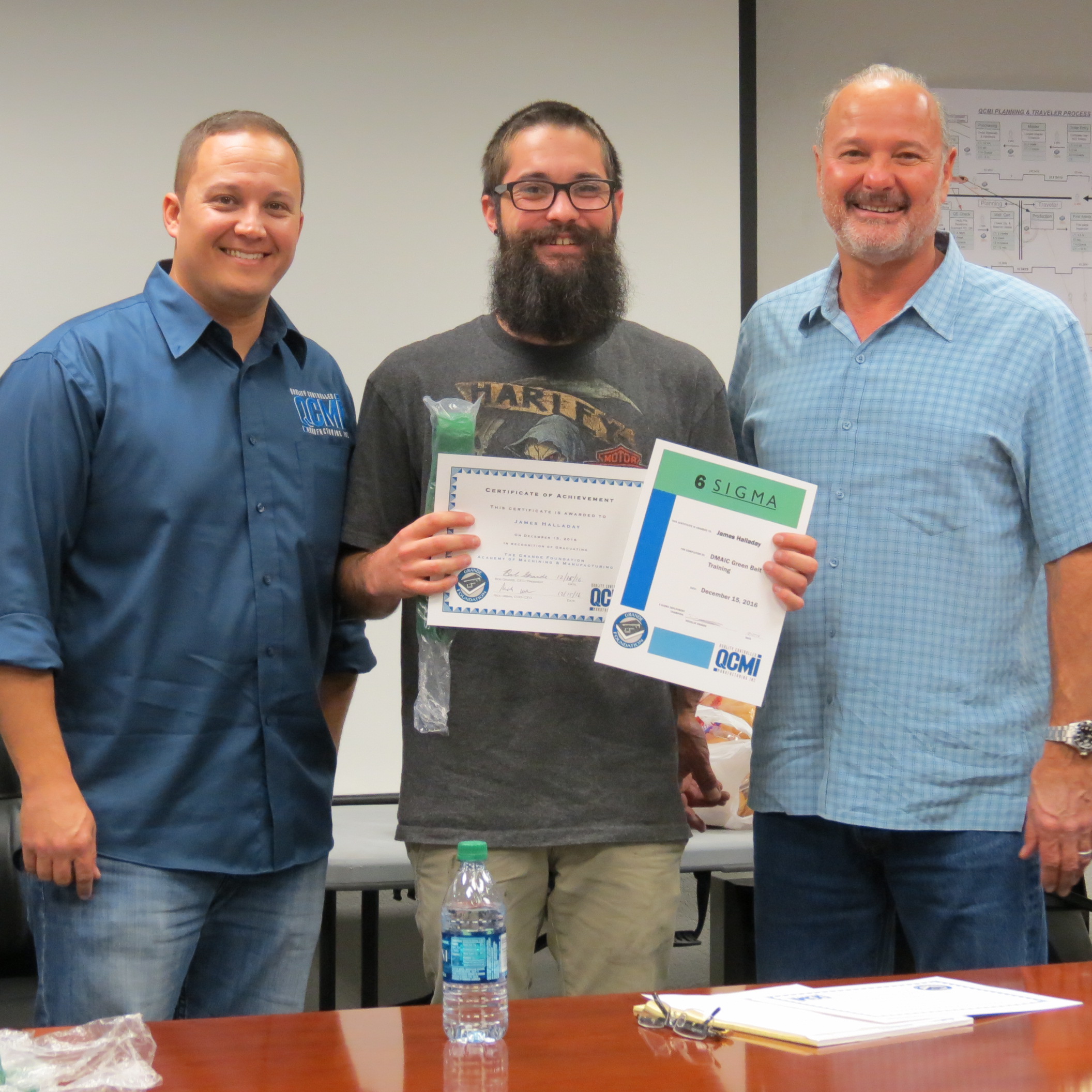
The main goal of Six Sigma is to better the overall processes in the manufacturing industry and to minimize noncomformances to 3.4 defects per million parts produced. This method consists of recognizing the reason for the defects and understanding the root cause of these issues and how to eliminate them from occurring again. By identifying areas where waste is prominent, a company is able to find ways to change their manufacturing procedures in order to reduce waste in future production. The Six Sigma Methodology strives to make performance more efficient with regards to time, cost, and resources. The levels of certification once training is complete are in the form of a martial arts “belt” system. The levels that represent what it means to be part of Six Sigma Manufacturing include: Top Executives, Six Sigma Champions, Master Black Belts, Black Belts, Green Belts, Yellow Belts, White Belts. The principles of lean manufacturing and the Six Sigma Methodology are implemented into The Grande Foundation Manufacturing Academy in order to promote efficiency and minimal waste throughout the entirety of the processes that are completed. All members who graduate from the Manufacturing Academy receive their Six Sigma Green Belt Certification. Through the Grande Foundation Manufacturing Academy, students will learn how to apply these principles to improve their next role and their company all while becoming a more integral and irreplaceable part of the manufacturing industry.
 Grande Foundation